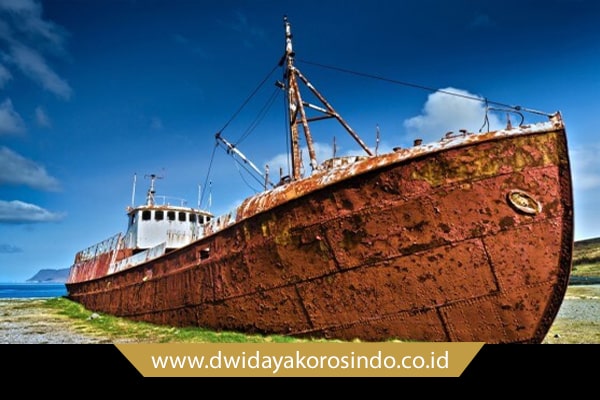



dwidayakorosindo.co.id – Corrosion is an event of degradation or damage to metals due to chemical reactions of metals with unwanted compounds. In everyday language, corrosion is also called rusting.
Metals can experience corrosion when in contact with acids and water. Corrosion to metals can also occur due to changes in temperature over a period of time and continuously.
An example of corrosion that is often encountered in everyday life is corrosion of iron. In the event of corrosion, iron will experience oxidation, while oxygen (air) is reduced.
Corrosion to metals can take place quickly or slowly, depending on the triggering factors. The following are some of the factors that cause corrosion (rusting) on metals.
1. Water and oxygen concentrations
In conditions of higher humidity, the iron will rust faster. In addition, rusting will also easily occur in water with higher dissolved oxygen levels. Water and oxygen can be a medium for corrosion and an oxidizing agent for iron.
2. Temperature
If the metal is in an area with hot temperatures, such as in a desert, the corrosion process will be slower. Conversely, if the metal is in a place with low temperature or cold area, it will corrode faster. This is in accordance with the principle of reaction rate, where the reaction rate will increase with increasing temperature.
3. The degree of acidity (pH)
The corrosion reaction on metals will occur more quickly in an acidic atmosphere or a pH of less than 7. In the same atmosphere, the oxygen reduction reaction is more spontaneous, characterized by a greater reduction potential when compared to alkaline or neutral conditions.
4. Electrolyte as Load Transfer Media
Electrolyte is a very good medium for charge transfer. This makes it easier for oxygen in the air to bind to electrons. The iron in the factory environment will rust more easily, because it is too often exposed to acid compounds. Acidic rainwater and salty sea water can also act as a medium that accelerates corrosion.
5. Uneven metal surface
Uneven shape of metal surface can accelerate corrosion. This is caused by the formation of charge poles on the metal surface. There are charge poles that act as anodes and cathodes that trigger corrosion of the metal.
6. The formation of electrochemical cells
The background of the formation of this electrochemical cell is the presence of two metal surfaces that touch each other. If the metal surfaces that touch have different electrode potentials, an electrochemical cell will be formed.
When electrochemical cells are formed, metals with a lower electron potential will release electrons, so that oxidation occurs as the main cause of corrosion. This effect is also known as the galvanic coupling effect.
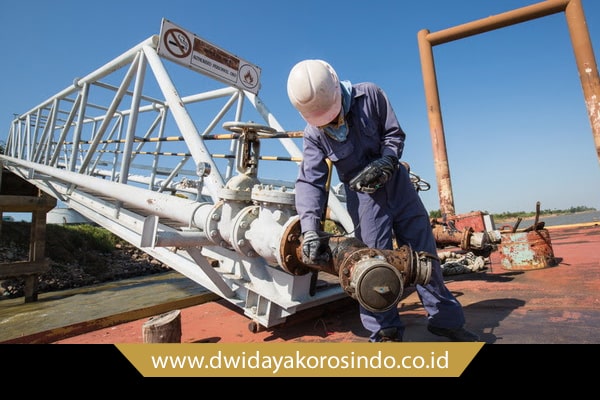
So, those are some of the factors that cause corrosion, usually in industrial industries such as the oil and gas, oil, oil, mining, and other industries also experience this, so you need a corrosion engineering, if you need coating services and reconditioning of equipment damaged by corrosion, please visit the website directly dwidayakorosindo.co.id and just consult with the admin.