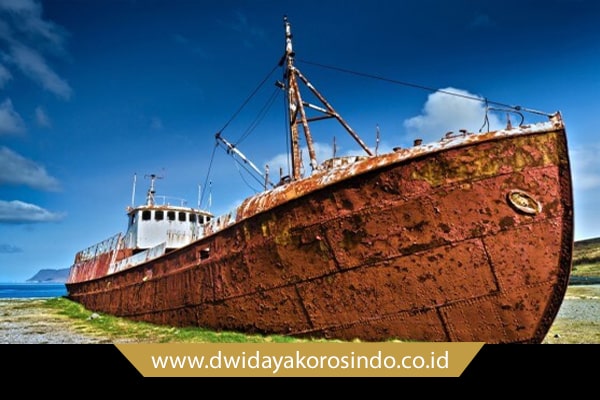


dwidayakorosindo.co.id – Most of the ship’s construction was made of steel plates. Steel plates for ship building have a high risk of damage due to corrosion. Corrosion in the construction of steel ships caused by sea water can result in a decrease in the strength of the construction and the life of the ship, thereby reducing the safety of cargo and ship passengers.
To avoid greater losses due to corrosion in ship construction due to sea water, corrosion protection is required on the ship plate, among others by using ship paint and the use of zinc anode in the part of ship construction that is immersed in sea water or if it has happened then you can also use services coating and reconditioning of construction damaged by corrosion.
Quoting from the National Association of Corrosion Engineers (NACE International), according to a book written by Fontana and Greene in 1967 there are 8 types of corrosion and ways to handle corrosion on ships that you can do :
1. Uniform Attack (Uniform Corrosion)
Usually characterized by chemical or electrochemical reactions that take place uniformly across exposed surfaces or over large areas. Chemical reactions occur due to the low pH of water and humid air, so that the longer the steel plate becomes thinner. This type of corrosion can be prevented by, among others, choosing the right steel plate material and its coating, being given a protective layer containing inhibitors and cathodic protection.
2. Galvanic or Two-Metal Corrosion (Galvanized Corrosion)
This corrosion occurs due to the presence of 2 different metals in one electrolyte so that metals that are more anodic will be corroded.
3.Crevice Corrosion
Corrosion that occurs in metals that are attached to other metals and in between there are gaps that can hold dirt and water so that there is a concentration of oxygen. This type of corrosion is usually caused by small holes, and crevices under bolt heads and rivets.
4. Pitting Corrosion (Hole Corrosion)
This corrosion causes localized holes in the metal surface. These holes may be small or large in diameter, but in most cases they are relatively small. Holes are sometimes isolated or so close together that they look like rough surfaces. Generally a hole can be described as a cavity or hole with a surface diameter of nearly the same. Pitting is one of the most damaging and dangerous forms of corrosion.
5. Intergranular Corrosion
Intergranular is corrosion localized in a narrow area and occurs at grain boundaries. Metal is an arrangement of crystal grains such as sand grains that make up sandstone. The grains are bonded to each other which then forms a microstructure. The presence of corrosion causes the grains to become weak, especially at the grain boundaries so that the metal loses strength.
6. Selective leaching
It is a process of removing one element from a solid alloy by a corrosion process.
7. Erosion Corrosion
Erosion corrosion is the acceleration of the rate of damage or attack to a metal due to the relative motion between the corrosive fluid and the metal surface. Generally, this movement is quite fast, and is associated with abrasion. Corrosion that occurs due to friction between corrosive liquids on the metal surface or due to very heavy fluid flow that can erode the protective layer or wear on the metal. This corrosion usually occurs in the pipe and propeller.
8. Stress-corrosion cracking
The stress corrosion mechanism occurs due to the relationship of 3 component factors, namely materials susceptible to corrosion, the presence of electrolyte solutions (environment) and the presence of stress. For example, copper is susceptible to ammonia compounds, mild steel is susceptible to alkaline solutions and stainless steel is susceptible to chloride. Marine corrosion has a significant impact on ship life.
Therefore an effective corrosion control strategy must be chosen by selecting the appropriate coating for the marine environment. The coating of the hull with paint has a special function to protect hull construction, especially those located below the waterline and ship construction above the water line. Painting on ships is usually called marine coatings, and there are 4 types of them:
So, those are some of the corrosion of ships as well as how to overcome them. For those of you who are in need of coating and reconditioning services for ship construction damaged by corrosion, please visit the dwidayakorosindo.co.id website and just consult the admin.